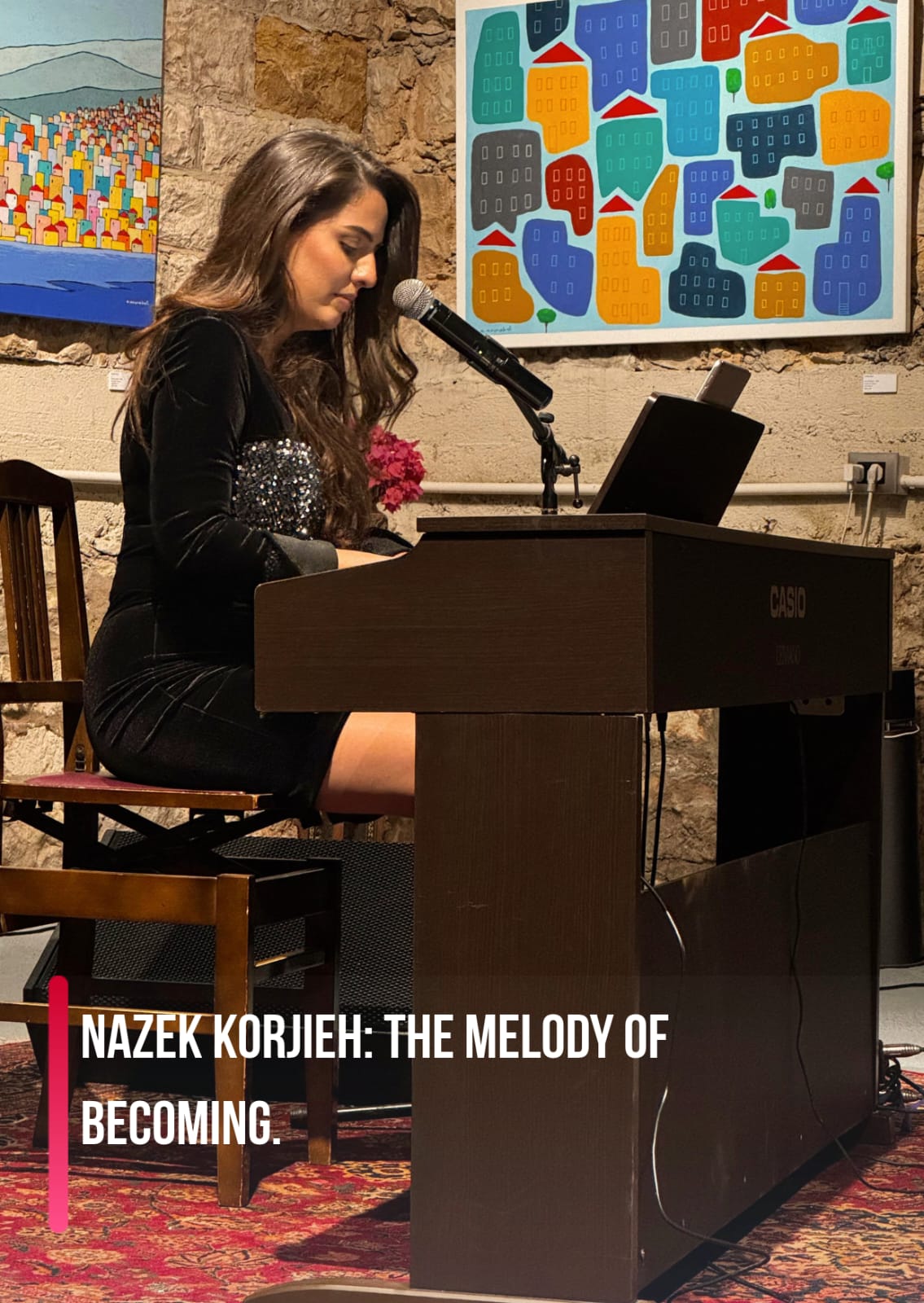
After a decade devoted to nurturing artistic talent in Lebanon, pianist and singer Nazek Korjieh is turning her attention to a more personal ambition: her own music.
Some passions have a way of remaining with us, regardless of where life takes us. For Lebanese pianist and singer Nazek Korjieh, music has been that constant presence. It has accompanied her through years of study, performances, teaching and the demanding experience of establishing her own arts institution. Today, after dedicating much of her life career to developing the talents of others, she is returning to the stage with a renewed desire to explore her identity as a musician.
Nazek’s path into the arts was not entirely conventional. She initially studied accounting, a discipline far removed from the creative world she would eventually embrace. Yet music was already an essential part of her life. Alongside her university studies, she pursued piano training and studied Oriental singing at the Lebanese National Higher Conservatory of Music.
It was during these formative years that she developed an artistic quality that would distinguish her performances: the ability to sing while accompanying herself on the piano.
Combining these two disciplines requires more than technical proficiency. The pianist must maintain rhythmic and harmonic control while the singer navigates phrasing, breath, melodic ornamentation and expression. In Arabic music, where vocal interpretation is deeply connected to the nuances of maqam and the flexibility of melodic lines, the relationship becomes particularly demanding.
For Nazek, this combination gradually became a natural part of her musical expression.
Her repertoire has included both classical Arabic songs and contemporary compositions, allowing her to explore different periods and styles within the region’s musical heritage. She has performed in solo concerts and participated in festivals in Lebanon and abroad, bringing her own interpretation to works that hold a special place in Arabic musical culture.
Alongside performing, she began developing an interest in composition. It was a desire to move beyond interpreting existing works and begin shaping musical ideas of her own. Although she has not yet released original compositions, writing music remains among her artistic ambitions.
In 2015, however, her career took a direction that would occupy much of the following decade.
Nazek founded Fan فن Institute in Saida, a coastal Lebanese city with a rich cultural history. Her intention was to create a place where artistic education could be accessible to children, young people and adults, regardless of whether they aspired to professional careers or simply wished to discover their creative abilities.
What began as an educational initiative developed into a multidisciplinary institute offering music, visual arts and creative workshops. Students could study piano, violin, guitar, percussion and singing, while others explored drawing, handcrafts and different forms of artistic expression.
For Nazek, the experience of learning an instrument or developing an artistic skill was never meant to end in the classroom. She placed importance on giving students opportunities to perform, exhibit their work and experience the relationship between an artist and an audience.
Concerts, exhibitions and artistic events became an integral part of Fan’s فن activities, contributing to the cultural life of Saida while offering students valuable practical experience.
Running the institute also meant assuming responsibilities that extended well beyond music. There were educational programmes to develop, activities to coordinate and the daily demands of maintaining a creative institution. It required organisation, patience and a long-term commitment to the community she had chosen to serve.
For nearly a decade, this work became a central part of Nazek’s professional life.
Yet the desire to pursue her own music never disappeared.
There is a particular complexity in being both an artist and an educator. Teaching requires generosity, attention and the ability to recognise potential in others. Performing, by contrast, asks for a different kind of commitment: the willingness to place one’s own interpretation, emotions and creative choices before an audience.
Nazek has spent years navigating both worlds. Now, she feels ready to give her personal artistic career the attention it has long deserved.
Her decision comes at a meaningful stage in her life. She is no longer the young musician discovering her abilities at the conservatory, but an experienced artist whose perspective has been shaped by years of working with students, musicians and different artistic disciplines.
She hopes to dedicate more time to singing, piano performance and composition, developing a body of work that reflects her musical background and personal sensibility.
The challenge will be to find her own place within a musical landscape that continues to evolve, while preserving the connection to Arabic musical traditions that has remained central to her training.
It is an ambition she approaches with years of experience behind her, but also with the uncertainty that accompanies any new artistic undertaking.
What makes Nazek’s story interesting is not a sudden transformation or a dramatic change of direction. It is the gradual evolution of a woman who has allowed her career to take different forms without losing sight of what first inspired her.
She has been a student, a performer, a teacher and the founder of an institution. Each role has demanded something different of her, and each has contributed to the musician she is today.
Fan فن Institute remains an important part of that journey, a reflection of her belief in the value of artistic education and the opportunities it can create.
But after years spent listening to students practise, watching them develop and encouraging them to find confidence in their abilities, Nazek is preparing to devote more of that same attention to her own work.
The next chapter may bring new performances, original compositions and a more defined musical identity. Much of it is still to be written.
For now, there is something deeply personal about her decision to return to the piano, not as a teacher guiding someone else’s hands, but as a musician ready to explore what she herself still has to say.